
Black Women: Pioneers of the Labor Movement

Updated: Jun 25, 2025

Prepared for Linked Arms (ADOES) Family Child Care Association Members and AFRAM Members of SEIU 925
By Mary Curry, Co-President, Linked Arms Association
QUEENS KNOW YOUR POWER, KNOW YOUR PLACE!
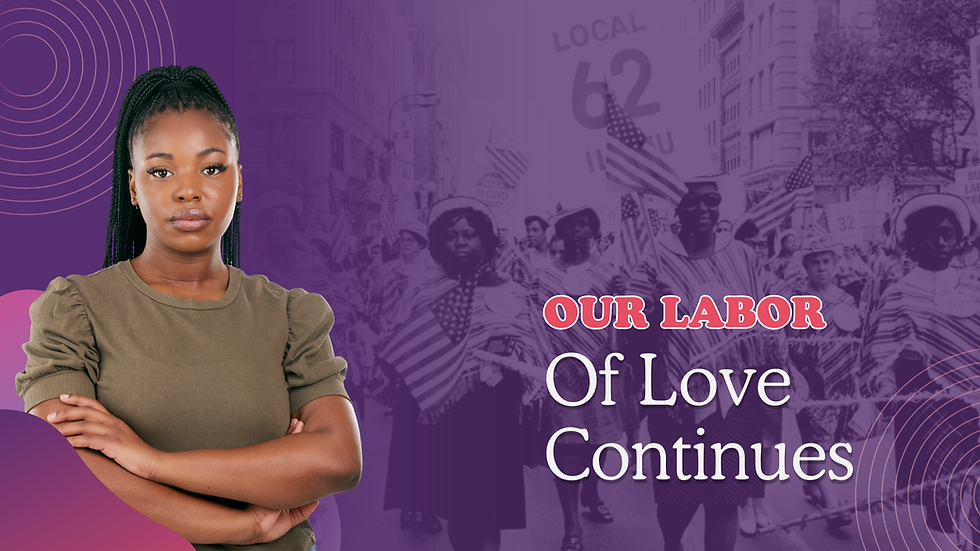
Introduction Throughout American history, Black women have been among the first to organize and unionize in pursuit of economic justice, human dignity, and collective power. Their labor activism was born out of necessity in a society that doubly marginalized them based on race and gender. While often overlooked in mainstream labor narratives, Black women were central to shaping union efforts and labor movements throughout U.S. history.
Reconstruction-Era Organizing (1860s–1880s) In 1866, shortly after Emancipation, Black laundresses in Jackson, Mississippi organized to demand fair wages and launched one of the first collective labor actions in the South. Similarly, the 1881 Atlanta Washerwomen's Strike mobilized over 3,000 Black women in a groundbreaking protest for higher wages and dignity in domestic labor. These early strikes laid the foundation for Black women's collective bargaining power.
Late 19th Century Trailblazers Lucy Parsons, a formerly enslaved woman, became a national labor leader in the 1880s. She helped found the Industrial Workers of the World (IWW), a union inclusive of all workers regardless of race or gender. Her organizing legacy showcased the leadership potential of Black women on the national stage.
Domestic Worker Activism (Early 20th Century) As Black women were largely confined to domestic work, they began forming their own unions. In 1934, Dora Lee Jones helped found the Harlem Domestic Workers Union, one of many efforts to combat wage theft and abuse in household employment. At the same time, Rosina Tucker helped organize the Ladies' Auxiliary of the Brotherhood of Sleeping Car Porters and expanded union organizing to laundry and hotel workers.
Black Women in Industrial Labor (1930s–1950s) With the rise of industrial jobs during the Great Depression and World War II, Black women like Sylvia Woods and Maida Springer Kemp joined and led strikes in the laundry and garment industries. Their union involvement helped shape worker protections and gender equity in labor policies. Kemp later became the first Black woman to represent American labor internationally.
Civil Rights and Labor Convergence (1950s–1960s) The March on Washington for Jobs and Freedom (1963) highlighted the connection between labor and civil rights. Women like Rosina Tucker, now a senior elder, mobilized communities to attend. Dorothy Lee Bolden continued this legacy by founding the National Domestic Workers Union of America in 1968, advocating for thousands of domestic workers to receive fair treatment and legal protections.
Legacy and Continuation (1970s–Today) Black women’s labor organizing continues today in service sectors, education, health care, and child care. The ongoing advocacy of Black women remains vital to ensuring inclusive labor policies and protections for all workers. Organizations such as Linked Arms (ADOES) and AFRAM within SEIU 925 carry forward this legacy.
Timeline Highlights
1866: Jackson, Mississippi Washerwomen organize and strike
1881: Atlanta Washerwomen Strike mobilizes 3,000+ workers
1886–1905: Lucy Parsons co-founds IWW and Working Women's Union
1925: Rosina Tucker organizes with the Brotherhood of Sleeping Car Porters
1934: Harlem Domestic Workers Union founded by Dora Lee Jones
1941: Executive Order 8802 opens defense jobs to Black workers
1963: March on Washington bridges labor and civil rights
1968: Dorothy Bolden launches National Domestic Workers Union of America
In Solidarity As members of the Linked Arms (ADOES) Association and AFRAM within SEIU 925, we honor the legacy of Black women who paved the way for labor rights. Their courage and organizing brilliance shaped a movement that continues to uplift our families and communities.
Lessons Learned
Collective Action Changes Systems
From the washerwomen of 1866 to the domestic worker unions of the 1960s, Black women have shown that unity, even among the most marginalized, can disrupt systems of exploitation and bring about real change.
Leadership is Rooted in Lived Experience
These women didn’t wait to be invited to the table—they built their own. Their firsthand knowledge of injustice became the foundation for powerful grassroots organizing.
Persistence in the Face of Exclusion
Black women were often excluded from white-dominated unions and labor protections, but they refused to be silenced. Their courage forged parallel pathways for justice when none existed.
Economic Justice is Civil Rights
The labor movements led by Black women were not separate from the civil rights movement—they were integral to it. Demanding fair pay and respect at work is a form of resistance and liberation.
History Repeats, So Must Resistance
The conditions Black women fought in the 1800s—low wages, disrespect, and lack of representation—still echo today. Their stories remind us to stay vigilant and proactive in the fight for dignity.
The Power Within
Ancestral Power
You are walking in the footsteps of Lucy Parsons, Rosina Tucker, Dorothy Bolden, and thousands of unnamed heroines. Their power flows through you. Their legacy lives in your advocacy.
The Power to Organize
Whether you’re a provider, teacher, caregiver, parent or advocate—your voice matters. You carry the power to call a meeting, lead a march, challenge a system, and demand what is rightfully yours.
The Power of Place
“Know your place” doesn’t mean accept oppression—it means own your rightful place as a builder of justice, a leader of your community, and a Queen in your movement.'
The Power of Representation
When Black women lead, the whole community rises. Your visibility, your leadership, and your lived truth transform policies, workplaces, and futures.
The Power of Legacy
You are not starting from scratch. You are continuing a sacred labor movement rooted in freedom, dignity, and care. You are the proof that their fight was not in vain—and the hope that change will continue.

Comments